When electricity has to travel across long distances, the conductor is doing much more than carrying current. It also has to deal with mechanical tension, wind, temperature changes, installation conditions, and the physical demands of the transmission route. That is why Aluminum Conductors used in overhead power transmission are available in several different constructions rather than one universal design.
Common conductor families include AAC, AAAC, ACSR, ACAR, and several newer aluminum-based reinforced conductors. Their differences come mainly from the materials used in the conducting strands, the arrangement of those strands, and the way mechanical strength is provided. Some designs rely mainly on aluminum or aluminum alloy, while others combine aluminum with steel or composite reinforcement.
Understanding these conductor types makes it easier to see why a transmission project may use one construction in one location and a different construction elsewhere. The choice is connected to the electrical requirements of the line, the span arrangement, mechanical loading, operating temperature, and the condition of the existing infrastructure.
Why Are Different Aluminum Conductors Used for Transmission?
At first glance, an overhead conductor may appear to be a simple group of metal wires twisted together. In practice, its internal structure has a direct effect on how the conductor behaves once it is installed.
A transmission conductor has two basic jobs.
The first is electrical. The aluminum strands provide the path for current.
The second is mechanical. The conductor has to support its own weight and withstand tension between supporting structures while remaining within the intended operating conditions.
These two requirements do not always point toward the same material arrangement.
A conductor with a large amount of conducting aluminum can provide useful electrical characteristics, but the mechanical design still needs to support the conductor across the line route. A reinforced conductor can provide additional mechanical strength, but the reinforcement may change weight, thermal behavior, and other characteristics.
This is why conductor families have evolved around different combinations of aluminum, aluminum alloys, steel, and composite materials. The U.S. Department of Energy describes conventional and advanced overhead conductor designs in terms of these different approaches.
A simple comparison
| Conductor Type | Main Construction | Typical Design Focus |
|---|---|---|
| AAC | Aluminum strands | Electrical conductivity and relatively simple construction |
| AAAC | Aluminum alloy strands | Strength without a separate steel core |
| ACSR | Aluminum strands around a steel core | Electrical conduction with strong mechanical support |
| ACAR | Aluminum and aluminum alloy strands | Balance between electrical and mechanical properties |
| ACSS | Aluminum strands with steel support | High-temperature operation and mechanical support |
| ACCC | Aluminum strands around a composite core | High-temperature, low-sag transmission applications |
| ACCR | Aluminum alloy strands around a composite reinforcement | Higher-temperature transmission applications |
| ACFR | Aluminum-based conducting strands with carbon fiber reinforcement | Advanced conductor applications |
The exact construction, material grades, strand arrangement, and performance depend on the conductor design and applicable specification.
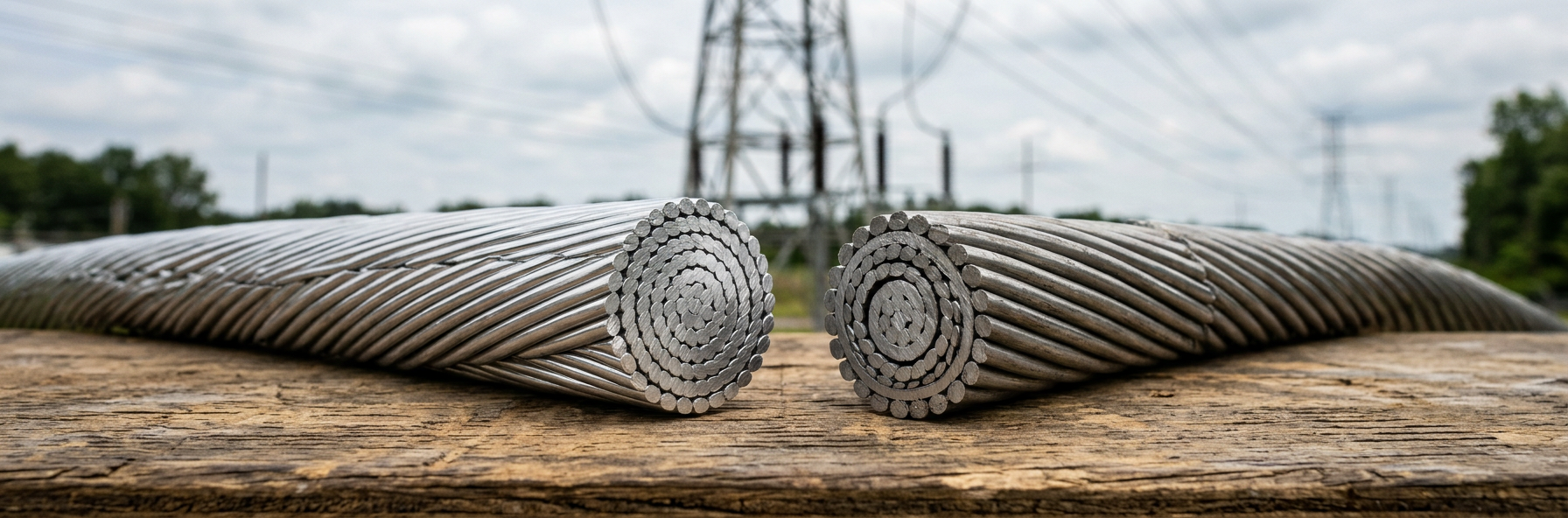
1. AAC: All Aluminum Conductor
AAC stands for All Aluminum Conductor.
As the name suggests, the conductor is made from aluminum strands without a separate steel reinforcing core. This makes the construction relatively straightforward compared with reinforced conductor designs.
AAC has been used in electrical power systems for many years. It can be found in overhead electrical applications where the required mechanical conditions are compatible with an aluminum-only conductor.
The main point to understand about AAC is that its electrical and mechanical characteristics come from the aluminum strands themselves.
This can make AAC suitable for certain distribution and transmission-related applications, but the conductor selection still depends heavily on span length, mechanical loading, environmental conditions, and project requirements.
Where does AAC fit?
AAC may be considered when a project places greater emphasis on the electrical properties of an aluminum conductor and does not require the additional mechanical reinforcement provided by a steel or composite core.
Its construction can also make the conductor easier to identify during specification review.
However, AAC should not be selected simply because it contains aluminum. The complete line design determines whether an aluminum-only conductor is appropriate.
The relationship between conductor strength, sag, span, and operating conditions needs to be evaluated as part of the transmission design.
2. AAAC: All Aluminum Alloy Conductor
AAAC stands for All Aluminum Alloy Conductor.
Unlike AAC, which uses aluminum strands, AAAC uses aluminum alloy strands to improve mechanical characteristics without introducing a separate steel core.
This distinction is important.
The addition of suitable alloying elements changes the mechanical behavior of the conductor while retaining an aluminum-based conducting structure. The U.S. Department of Energy notes that aluminum alloy conductors were developed to improve the mechanical characteristics of all-aluminum conductors and that AAAC is used in overhead applications.
AAAC can therefore occupy a useful position between traditional all-aluminum construction and reinforced conductor designs.
Why choose an aluminum alloy?
Transmission lines have to manage more than electrical current.
A conductor is suspended between supporting structures, so mechanical strength matters. The conductor can also experience temperature changes, vibration, wind, and long-term mechanical loading.
Using an aluminum alloy can alter the balance between conductivity and mechanical properties.
That does not mean AAAC is suitable for every transmission line. Its characteristics need to be matched with the route, span arrangement, loading conditions, and electrical requirements.
Recent transmission projects also show that AAAC can be selected for reconductoring and overhead line upgrades, demonstrating that it remains relevant in modern grid work.
3. ACSR: Aluminum Conductor Steel Reinforced
ACSR stands for Aluminum Conductor Steel Reinforced.
This conductor combines aluminum conducting strands with a steel core. The aluminum carries the electrical current, while the steel provides substantial mechanical support.
This construction has become widely established in overhead power systems because it separates two important functions within the conductor.
The outer aluminum layers provide the conducting path.
The internal steel core provides mechanical strength.
This arrangement gives engineers flexibility when designing overhead lines that need a combination of electrical capacity and mechanical support.
The U.S. Department of Energy identifies ACSR as a widely deployed overhead conductor and describes its construction as aluminum wires stranded around a coated steel core.
Why is the steel core important?
Imagine a long conductor suspended between two structures.
The conductor has its own weight. It is also exposed to external forces and mechanical tension. If the conductor stretches too much, the clearance between the conductor and the ground or surrounding infrastructure can change.
The steel core helps provide the mechanical support needed for this type of installation.
Different ACSR constructions can vary in the relationship between aluminum and steel. That allows the conductor design to be adapted to different mechanical requirements.
This is one reason ACSR appears in many different overhead line applications rather than being limited to one specific type of electrical network.
4. ACAR: Aluminum Conductor Alloy Reinforced
ACAR stands for Aluminum Conductor Alloy Reinforced.
Instead of using a steel core, ACAR combines aluminum and aluminum alloy strands within the conductor structure.
The aluminum contributes to electrical conduction, while the aluminum alloy provides additional mechanical support.
This gives ACAR a different balance from both AAC and ACSR.
The U.S. Department of Energy lists ACAR among established overhead conductor technologies and identifies it as an aluminum conductor alloy reinforced design.
What makes ACAR different?
The key difference is the reinforcement material.
AAC uses aluminum strands.
AAAC uses aluminum alloy strands throughout the conductor.
ACSR uses aluminum strands around a steel core.
ACAR combines aluminum and aluminum alloy within the conductor.
This approach allows conductor designers to adjust the relationship between electrical and mechanical characteristics through the strand arrangement.
For transmission applications, that flexibility can be useful when the line design has specific requirements for current carrying capability, mechanical loading, weight, or installation conditions.
5. ACSS: Aluminum Conductor Steel Supported
ACSS stands for Aluminum Conductor Steel Supported.
The basic concept is similar to ACSR because steel provides the mechanical support while aluminum strands carry the electrical current.
The important distinction is the way the aluminum and steel are designed to behave under elevated operating temperatures.
ACSS belongs to a group of conductors developed for situations where thermal performance and conductor sag are important design considerations.
When an overhead conductor heats up, its length can change. This can affect sag and ground clearance. Transmission engineers therefore need to consider the thermal behavior of the conductor rather than looking only at its electrical capacity.
ACSS uses a steel-supported structure that allows the conductor to operate differently from conventional ACSR designs under elevated temperatures.
It can therefore be considered for transmission applications where thermal operating conditions are an important part of the design review.
6. High-Temperature Aluminum Alloy Conductors
Transmission networks sometimes require conductors that can operate under higher thermal conditions than conventional designs.
This has encouraged the development of high-temperature aluminum alloy conductors.
These conductors use aluminum alloys specifically selected for their behavior under elevated operating conditions. Some designs also incorporate modified support structures to control thermal expansion and sag.
This category is not a single conductor type. Instead, it represents a group of approaches that modify aluminum alloys, reinforcement materials, or internal construction.
The underlying idea is straightforward:
The conductor needs to carry electrical current while maintaining acceptable mechanical behavior as its temperature changes.
That becomes particularly relevant when an existing transmission corridor needs additional electrical capacity but rebuilding the entire supporting infrastructure would be difficult.
Advanced conductor technologies have been developed specifically to address issues such as higher current-carrying capability, lower sag at elevated temperatures, and mechanical strength.
7. ACCC: Aluminum Conductor Composite Core
ACCC stands for Aluminum Conductor Composite Core.
This type of advanced conductor replaces the traditional steel reinforcement approach with a composite core.
The core provides mechanical support while aluminum strands surrounding the core provide the electrical conducting path.
The use of a composite core changes the relationship between conductor strength, weight, thermal expansion, and electrical capacity.
This type of conductor is particularly relevant when a transmission project is looking at reconductoring or increasing the electrical capability of an existing line while considering the limitations of existing structures.
The U.S. Department of Energy describes ACCC as using a composite core surrounded by aluminum strands and identifies its low thermal expansion as one of the characteristics associated with reduced sag at elevated temperatures.
Why does the core matter?
The core is not simply a filler inside the conductor.
It plays an important structural role.
When the conductor temperature changes, the core and aluminum layers respond according to their respective material characteristics. The relationship between these materials influences how the overall conductor behaves under thermal and mechanical loading.
That is why advanced conductor designs need to be evaluated as complete constructions rather than by looking at the aluminum strand alone.
8. ACCR: Aluminum Conductor Composite Reinforced
ACCR stands for Aluminum Conductor Composite Reinforced.
It uses an aluminum-based composite reinforcement surrounded by conducting aluminum alloy strands.
The design is intended for transmission applications where mechanical strength and elevated-temperature operation are important considerations.
Compared with a conventional steel-reinforced conductor, the internal reinforcement material behaves differently under temperature changes. This can influence the conductor's ability to operate at higher temperatures while controlling thermal expansion and sag.
Recent transmission projects have used ACCR in reconductoring work where existing infrastructure placed practical limits on conventional conductor replacement. The U.S. Department of Energy has described ACCR as an advanced conductor using an aluminum matrix composite core with aluminum-zirconium alloy outer strands.
This type of application illustrates an important point about advanced conductors.
They are not simply designed to replace conventional wire everywhere.
They are considered when the existing line, electrical demand, mechanical conditions, and project constraints create a reason to examine a different conductor construction.
9. ACFR: Aluminum Conductor Carbon Fiber Reinforced
ACFR stands for Aluminum Conductor Carbon Fiber Reinforced.
As the name indicates, carbon fiber reinforcement is used within the conductor structure.
The conducting layers can contain aluminum or aluminum alloy strands, while the carbon fiber-based core provides mechanical support.
This type of construction belongs to the broader family of advanced overhead conductors.
Carbon fiber can offer a different combination of mechanical strength, thermal expansion behavior, and weight compared with traditional steel reinforcement.
The U.S. Department of Energy identifies ACFR among advanced overhead conductor technologies and describes its carbon fiber reinforcement and aluminum-based conducting layers.
For transmission engineers, the significance lies in the complete conductor behavior.
A new core material can change how the conductor responds to temperature, mechanical loading, and installation forces. That means the supporting structures, fittings, installation methods, and operating conditions still need to be evaluated together.
10. Gap-Type and Invar-Based Conductor Designs
Some advanced transmission conductors continue to use steel-based reinforcement but change the way the aluminum strands and core interact.
Gap-type conductors and Invar-based designs are examples of this approach.
In a gap-type design, the arrangement between the aluminum strands and the core allows the conductor to behave differently under thermal loading.
Invar-based designs use an alloy with a low thermal expansion characteristic as the reinforcing material.
These designs are intended for applications where higher operating temperatures and control of conductor sag are important.
The engineering principle is similar to other advanced conductor technologies: modify the material combination and internal structure so that electrical and mechanical requirements can be managed together.
This is especially relevant when a project is trying to increase transmission capability without making a complete change to the supporting structures.
How Do These Aluminum Conductors Differ?
Looking at the conductor names one by one can make the subject seem complicated. A simpler way to understand them is to focus on the internal structure.
| Conductor | Conducting Material | Reinforcement | General Design Idea |
|---|---|---|---|
| AAC | Aluminum | Aluminum strands | Simple all-aluminum construction |
| AAAC | Aluminum alloy | Aluminum alloy strands | Alloy-based mechanical improvement |
| ACSR | Aluminum | Steel core | Aluminum conduction with steel support |
| ACAR | Aluminum and aluminum alloy | Aluminum alloy | Combined electrical and mechanical design |
| ACSS | Aluminum | Steel support | Thermal and mechanical performance |
| ACCC | Aluminum | Composite core | Composite reinforcement and thermal control |
| ACCR | Aluminum alloy | Aluminum matrix composite | Advanced high-temperature construction |
| ACFR | Aluminum or aluminum alloy | Carbon fiber | Composite mechanical reinforcement |
The table is useful as a starting point, but it should not be treated as a conductor selection rule.
Actual selection depends on the transmission route and the technical requirements of the project.
What Factors Influence Conductor Selection?
Choosing an aluminum conductor for transmission involves several connected considerations.
Electrical requirements
The conductor needs to provide the required electrical path for the transmission system. Resistance, current carrying capability, and the overall electrical design all matter.
The conductor cannot be selected based on the material name alone.
Mechanical loading
Overhead conductors are suspended structures.
Their own weight, wind, tension, vibration, and other mechanical forces influence the line design.
A conductor suitable for one span arrangement may not be suitable for another.
Temperature
Electrical current produces heat in the conductor.
As temperature changes, the conductor can expand, and its mechanical behavior can change. For this reason, thermal performance becomes particularly important when transmission systems are operated under demanding conditions.
Sag and clearance
Sag is closely connected to conductor temperature, mechanical loading, and span arrangement.
Transmission engineers need to maintain appropriate clearances from the ground, structures, roads, and other infrastructure.
A conductor's thermal and mechanical characteristics therefore influence the physical design of the line.
Existing infrastructure
New transmission construction and reconductoring are not always the same problem.
When an existing line is upgraded, the available towers, poles, crossarms, foundations, fittings, and right-of-way may already be established.
A conductor that can work within the existing infrastructure can be attractive for a particular project because the conductor choice becomes part of a larger engineering decision.
How Does Conductor Construction Affect Installation?
The internal structure of a conductor also matters during installation.
Stranded conductors have to be handled carefully during transportation, stringing, tensioning, sagging, and connection work.
Damage to individual aluminum strands can affect the conductor's mechanical and electrical condition. Proper handling procedures are therefore important throughout installation.
Fittings also need to match the conductor construction.
Compression fittings, suspension fittings, dead-end assemblies, and other hardware are designed around specific conductor characteristics. Incorrect fitting selection can create mechanical or electrical problems.
For this reason, a conductor should always be considered together with its associated fittings and installation method.
Why Are Aluminum Alloys Important in Transmission Conductors?
Pure aluminum provides useful electrical conductivity, but transmission conductors also need mechanical characteristics suitable for overhead installation.
This is where aluminum alloys become important.
Alloying can change strength, thermal behavior, and other mechanical characteristics while retaining an aluminum-based conductor structure.
AAAC and ACAR demonstrate two different ways aluminum alloy can be incorporated into an overhead conductor.
Advanced conductors take this concept further by combining aluminum alloys with specialized cores or reinforcement systems.
The goal is not simply to make the conductor stronger.
The real engineering challenge is to balance:
- Electrical conductivity
- Mechanical strength
- Conductor weight
- Thermal behavior
- Sag characteristics
- Installation requirements
- Long-term operating conditions
Different conductor constructions place different emphasis on these factors.
What Should Buyers Check When Specifying Aluminum Conductors?
A purchase specification should describe the actual conductor required rather than relying on a general phrase such as "aluminum transmission wire."
Useful information can include:
- Conductor type
- Conductor construction
- Aluminum or aluminum alloy material
- Reinforcement material
- Strand arrangement
- Applicable specification
- Electrical characteristics
- Mechanical characteristics
- Operating conditions
- Installation environment
- Required fittings
- Packaging and handling requirements
Clear documentation helps prevent confusion between conductor families that may look similar from the outside.
For example, AAC and ACSR are both aluminum-based conductors, but their internal structures are very different. AAAC and ACAR also use aluminum alloy in different ways.
A specification review should therefore confirm the complete conductor designation and construction before production or procurement.
A Practical Way to Understand Aluminum Transmission Conductors
If the abbreviations feel difficult to remember, start with the conductor core.
Ask three simple questions:
Is the conductor made entirely from aluminum or aluminum alloy?
If yes, AAC or AAAC may be relevant depending on the material construction.
Does it use a steel core or steel support?
If yes, ACSR or ACSS may be relevant.
Does it use a composite reinforcement system?
If yes, an advanced conductor such as ACCC, ACCR, or ACFR may be under consideration.
This approach does not replace engineering evaluation, but it makes the terminology much easier to understand.
The types of Aluminum Conductors used in power transmission range from straightforward all-aluminum constructions to reinforced and composite-core designs. AAC, AAAC, ACSR, ACAR, ACSS, ACCC, ACCR, and ACFR each use different material combinations and internal structures to address the electrical and mechanical demands of overhead transmission.
The important distinction is not simply which conductor contains aluminum. It is how the aluminum is combined with alloy strands, steel support, or composite reinforcement and how that construction fits the transmission system.
For manufacturers, engineers, and buyers, understanding conductor construction helps make specifications clearer and reduces confusion during product selection. The appropriate choice depends on the transmission route, electrical requirements, mechanical loading, thermal conditions, existing infrastructure, installation method, and applicable technical requirements.
In other words, there is no single aluminum conductor design for every transmission application. The useful approach is to understand what each construction is designed to do and then evaluate it against the actual conditions of the power transmission system.